Kat Zet III
The Zone of InterestKat Zet III was a camp built entirely with IG Farben financing and designed as a close replica of Kat Zet I and Kat Zet II. When the narrator walked through it at dusk, the camp was still under construction, with only a colony of builders quartered there. Its emerging landscape joined the machinery of imprisonment to the demands of nearby industrial production, while debates about labor, starvation, and mass death exposed the violence embedded in that relationship.
Construction and Setting
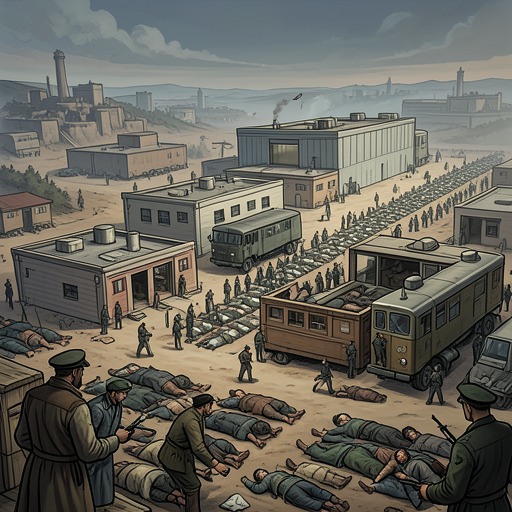
Kat Zet III was assembled with what the narrator calls a literalist’s care on the model of the two earlier camps. That replication extended beyond a general design: its planned and existing features included searchlights, watchtowers, barbed wire, high-tension fencing, sirens, gallows, armed guards, punishment cells, an orchestra bay, a whipping post, a brothel, a hospital, and a mortuary. The repeated list makes the new camp legible as an extension of an established system, not as an improvised worksite.
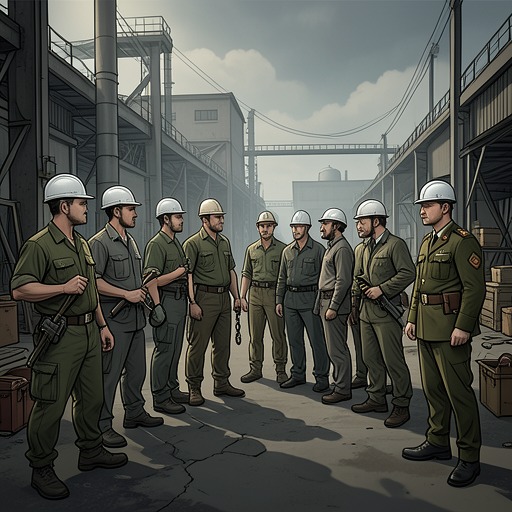
The narrator’s walk through muddy alleys took place in the late dusk on a Friday. Despite the elaborate infrastructure already in place, Kat Zet III remained unfinished. At that point, its population consisted only of builders, and the Labour Section registrar located a particular prisoner in Block 4(vi). The contrast between construction and operation is important: the camp’s institutional form was already recognizable even as the site itself was still being completed.
The Camp and the Buna Labor Regime
Kat Zet III’s industrial setting is illuminated by a meeting about labor for the Buna-Werke. Suitbert Seedig described workers rising at three in the morning, making a ninety-minute march to Buna, working until six in the evening, and returning by eight. They were already exhausted before the shift began, and some came back carrying casualties. Seedig’s question was not how to prevent those conditions but how useful workers could remain under them.
The discussion put figures to the depletion. Seedig said prisoners were still dying at a rate of a thousand a week. In another exchange, Frithuric Burckl contrasted an estimated 2,500 calories needed daily by an adult at complete rest with 300 calories in some Polish ghettos, eight hundred in the Stammlager, and about 1,100 at Kat Zet III, if prisoners were lucky. At that intake, he said, a heavy worker lost about three kilograms a week. His proposed response was a modest ration increase of twenty per cent, on the grounds that workers would last longer and have more strength. The argument treated nourishment as a calculation about usable labor and its duration, not as relief from a system of deprivation.
The surrounding administrative conflict sharpened the contradiction. The narrator described pressure from the Economic Administration Head Office to increase labor strength for the munitions industries, while other authorities pressed for the removal of evacuees. In the same reflection, he objected to a proposal that able-bodied mothers be worked in a boot factory until they collapsed, pointing to the practical and human impossibility of separating them from their children at the ramp. The competing demands did not resolve the violence; they exposed how labor extraction and deportation operated side by side.
Industrial Exploitation and Disposable Lives
A letter encountered at the Buna-Werke showed the treatment of prisoners extending beyond forced labor. The chief personnel officer at Bayer, a pharmaceutical subsidiary of IG Farben, reported that a transport of 150 women had arrived in good condition but that all had died during experiments. The letter requested another group of the same number and at the same price. The narrator’s immediate response was to ask what women cost. This episode is reported in the Buna-Werke office, not as an event established to have taken place at Kat Zet III; it nevertheless reveals the wider industrial network around the camp and its conversion of human lives into a replaceable supply.
The Buna labor debate used the same logic in a different register. Burckl argued for more food because workers would survive longer; Seedig’s account of deaths and exhausted returnees showed the human cost of the existing arrangement. The camp’s replicated infrastructure of punishment and confinement stood alongside this managerial arithmetic. In both settings, people were treated as resources whose condition mattered chiefly insofar as it affected their use or replacement.
Extermination Policy and the Limits of Production
The wider political history discussed in the narrative makes clear that industrial efficiency was not the sole purpose or limit of the violence. In a retrospective account of the policy described as the crime without a name, a speaker identified July 31, 1941, as a decisive point: an authorization followed by pressure from officials in Poland as deportation and annexation increased the number of Jews under Nazi control. The account traces a shift from imagined removal to a policy that included women and children, as well as men already being killed.
The same discussion rejects the idea that the industrial apparatus of gas chambers and crematories was the source of the murderous will. Those facilities, the speaker argued, accelerated killing, economized effort, and spared the nerves of the killers; bullets and pyres could have served the purpose in their absence. He cited the Einsatzgruppen’s killings by shooting to insist that the means could change without altering the intent. Kat Zet III’s gallows, guards, punishment cells, and mortuary therefore belong to a system in which forced labor and annihilation were not mutually exclusive aims.
Postwar Record and Significance
The promised industrial productivity was never achieved at the Buna-Werke: not a kilogram of synthetic rubber or a millilitre of synthetic fuel was produced. At Nuremberg in July 1948, thirteen IG Farben executives and managers were convicted, though Frithuric Burckl was not among them. Suitbert Seedig received an eight-year prison sentence for slavery and mass murder. These outcomes place the camp’s labor regime within a corporate project whose intended products were never made, while the exploitation and deaths associated with it remained matters for postwar judgment.
Kat Zet III is significant as both a physical extension of the camp system and a point of contact between confinement and industrial ambition. Its careful imitation of the older camps made coercive institutions reproducible; its unfinished state shows that this system was still expanding. The discussions surrounding Buna reveal the governing contradiction: prisoners could be demanded as laborers, starved until their capacity collapsed, and treated as disposable when they died. The camp’s architecture and the managers’ calculations present different faces of the same order.